
But it is less adventurous. It seems, at last, that in its eighth decade, Pakistan has settled into being a parliamentary democracy just like Bangladesh has and like we have always been, observes Aakar Patel.

Contradicting perceived proximity to the Soviet Union in the Cold War era, India under the then Prime Minister Rajiv Gandhi had toyed with the idea of supporting anti-Russian civilian groups in Pakistan if the then Zia regime was thrown out by Moscow, a recent declassified Central Investigation Agency document has claimed.

Alamgir said that even after the fall of the Hasina government following a people's uprising, the 'Indian establishment is yet to reach out to BNP, even though China, the US, the UK, and Pakistan have already done so.'
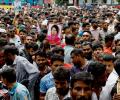
'We should be mindful that the religious minority community in one country is the majority in another (and) so treatment of the minority community in our respective countries will be an important variable in our relationship'

Bangladeshis on Sunday began voting in the general elections expected to be won by Prime Minister Sheikh Hasina in the absence of the main Opposition Bangladesh Nationalist Party (BNP) which is boycotting it.

'Bangladesh has become unstable and this instability will impact India.'

The main Opposition BNP of former premier Khaleda Zia, 78, who is under house arrest, is boycotting the elections amidst violence.

It was only a matter of hours before I would be declared persona non grata; all my work would turn to ashes, and I would be revealed as a typical untrustworthy Indian. I steeled myself for the axe to fall.

Sheikh Hasina was on Thursday sworn in as the prime minister of Bangladesh for the fifth term, days after her Awami League won an overwhelming majority in the general elections boycotted by the main opposition Bangladesh Nationalist Party (BNP) and its allies.

Bangladesh Prime Minister Sheikh Hasina on Sunday secured a record fourth straight term as her Awami League party won two-thirds of the seats in the general elections marred by sporadic violence and a boycott by the main opposition BNP and its allies.

The Democrats, especially the Biden administration, wanted to deliver a sharper message to Mr Modi than would be possible in a formal summit setting. So, why not get the most prominent Democrat in decades to deliver it?, explains Shekhar Gupta.

India's majoritarian regime is now making a dangerously fast-paced move towards theocracy, like its western counterpart did a few decades ago, warns Mohammad Sajjad.
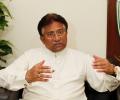
Learning perhaps from the Kargil debacle, Musharraf tried hard to evolve as a statesman in his dealings with India, recalls Rana Banerji, who headed the Pakistan desk at RA&W.
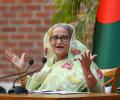
'Are we supposed to look the other way as Islamists go on a rampage against Hindus and the Hasina government pay lip service to secularism?' A revealing excerpt from Avishek Biswas and Deep Halder's book, Being Hindu In Bangladesh: The Untold Story.

The timing of these transfers, while being projected as routine, is significant in both strategic and political terms, asserts Rana Banerji, who headed the Pakistan desk at the Research and Analysis Wing, India's external intelligence agency.

The idea of weaponization got a fillip from an unexpected quarter. In the last week of October 1985, Rajiv met US President Ronald Reagan. Reagan told Rajiv, 'Pakistan has already made a bomb.' When Rajiv started talking about disarmament, the US president cut him short, 'Don't talk theory, think of your own protection.'

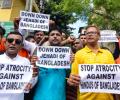
'Prime Minister Sheikh Hasina is sincere about maintaining religious harmony in the country.' 'But for mysterious reasons, it does not reach the grassroots activists of her party.'
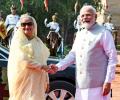
This is possibly the first time Hasina's daughter will be by her mother's side during an official visit to close neighbour and ally India, and analysts believe this to be significant in many ways.
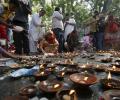
'There is no point in just saying, 'hum wapas bhej denge (we will send Kashmiri Pandits back)'.'

'Why has the rhetoric gone down on the Indian side, Durrani wondered aloud.' 'I said because almost total normalcy and peace had returned on the ground in Kashmir,' recalls Shekhar Gupta. 'The general gave me that career spook's laser look. And he said: "That situation on the ground can change in no time".' 'This was precisely when the Pakistanis began their first incursions into Kargil.' 'Durrani had been retired for five years.' 'But once the ISI boss, you are always in the know.'

'What we are today witnessing is the final act of the Pakistani army trying to retain its turf,' argues Colonel Anil A Athale (retd).

The modern world will not accommodate bigotry of the sort India is showing the world today, argues Aakar Patel.
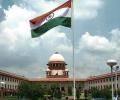
'What the long term repercussions of the Ayodhya judgment are will unfold in time.' 'And I hope the consequences are not going to be as damaging to us as they were to Pakistan,' says Aakar Patel.
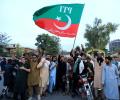
'Therefore, these people want Imran Khan out of the elections whenever it is held.' 'For this, he will have to be disqualified from contesting on the basis of cases against him, declaring that he is not sadiq (honest) and ameen (righteous).'

AQ Khan, a controversial scientist known as the father of Pakistan's clandestine nuclear programme, passed away here on Sunday after a brief illness. He was 85.

The late ICC chief Jagmohan Dalmiya supported PCB a lot in the Shoaib Akhtar bowling action case. He took a stand for PCB despite the ICC members insisting that Akhtar's bowling action was illegal.
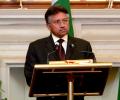
To consider Pervez Musharraf a real force for peace is an absurdity, declares Ambassador T P Sreenivasan.

Army Chief General M M Naravane carried out an aerial reconnaissance of forward areas on Wednesday and was briefed about the prevailing security situation along the Line of Control (LOC) in the Jammu region, officials said.
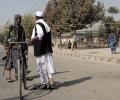
Pakistan would want to take full advantage of the situation to direct Taliban trained terrorists into the Kashmir Valley, alert Lieutenant General Ashok Joshi (retd) and Colonel Anil A Athale (retd).

'Afghanistan cannot be at peace until the Pashtuns regain their pre-eminent role in the country's governance,' says Ambassador M K Bhadrakumar.

'What is required is to make Pakistan less war-like and more modest in its ambitions. To normalise with India and to reduce the State's fondness for religion.' 'It is pragmatism and not charisma that it required and it is by being boring and not heroic that this can be achieved.' 'This is the moment of realisation which brings the Pakistani leader into conflict with the army.' 'Imran Khan will learn the lesson in time,' says Aakar Patel.

Gen Ahmadzai was scheduled to arrive in New Delhi on Tuesday on a three-day visit to explore ways to deepen bilateral military ties in the backdrop of the Taliban carrying out offensive operations across Afghanistan following the withdrawal of foreign forces.

'By annoying the Arabs and cozying up to Iran, Pakistan may end up losing Arab economic support, annoying the Americans and increase Shia-Sunni tensions domestically,' Colonel Anil A Athale (retd) points out.

'When it vanishes as a national force (meaning when it can no longer get sufficient votes to hold onto its symbol, the hand) it will not have been the first large Indian party to die,' says Aakar Patel.

ISI chief Faiz Hameed coerced the Taliban to announce an interim government guaranteed to preserve Pakistan's control over the levers of power in Kabul, observes Ambassador M K Bhadrakumar.

'This poem was written against a fundamentalist called Zia-ul-Haq, a dictator. It is interesting that fundamentalists, all kinds of, don't like this poem'

There is a great danger of the government getting stampeded into actions in Kashmir that could result in long lasting damage, warns Colonel Anil A Athale (retd).

'The generals couldn't care less about political corruption, being complicit themselves.' 'Coup d'etats are out of fashion.' 'Their only desire is backroom control,' says Sunil Sethi.

Water is going to be a central part of the government's 2024 election campaign. And Gajendra Singh Shekhawat's work will be crucial for it.
